
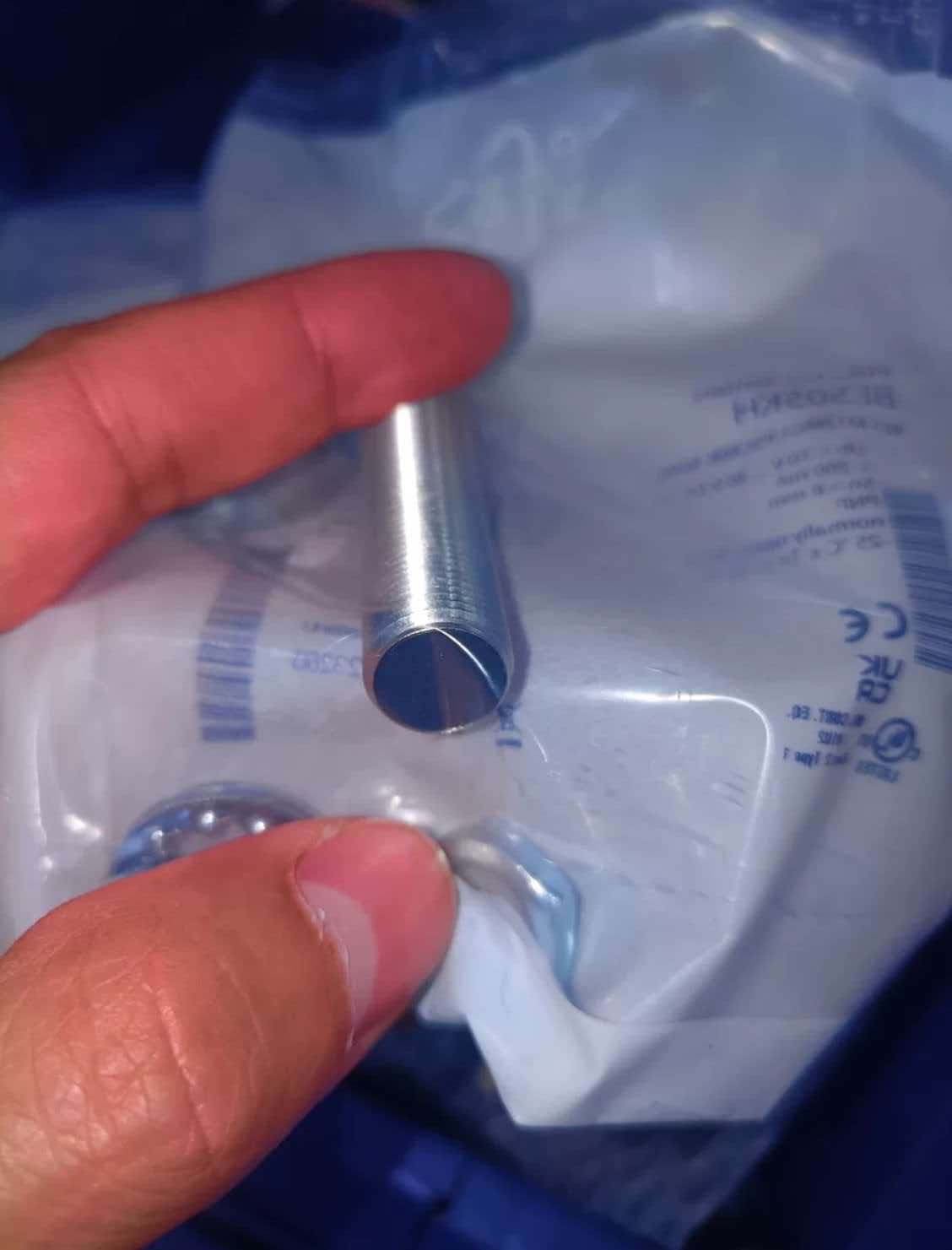
At a Glance. The Balluff BES inductive sensor family covers every standard machine-building proximity task, and the three brass cylindrical sizes — BES M12, BES M18 and BES M30 — account for most selections. All three are flush-mountable, all switch PNP NO into a 10-30 VDC supply, and all carry IP67 protection, so the choice almost always comes down to two practical questions: how far away is the target and how much mounting space do you have. The sensing distances scale with the housing: 4 mm flush on the M12, 8 mm flush on the M18 and 15 mm flush on the M30. Pick the smallest housing that meets your required sensing gap — that keeps bracket machining, spare-part variety and replacement swaps simple.
1. Head-to-Head: BES M12 vs M18 vs M30
| Specification | BES M12 | BES M18 | BES M30 |
|---|---|---|---|
| Housing | M12 cylindrical, brass | M18 cylindrical, brass | M30 cylindrical, brass |
| Switching distance (flush) | 4 mm | 8 mm | 15 mm |
| Output | PNP NO | PNP NO | PNP NO |
| Supply voltage | 10-30 V DC | 10-30 V DC | 10-30 V DC |
| Connector | M12 4-pin | M12 4-pin | — |
| Protection | IP67 | IP67 | IP67 |
| Operating temperature | −25 °C to +70 °C | −25 °C to +70 °C | — |
| Best for | Tight slots, small targets, robot grippers | General machine sensing, the universal default | Long gaps, large targets, harsh washdown frames |
| Product page | BES M12 | BES M18 | BES M30 |
Note the consistent electrical platform: identical PNP NO output logic and the same 10-30 VDC supply window across all three sizes means you can interchange housings in a control scheme without touching PLC input cards or wiring logic.
2. Choosing by Sensing Distance
Up to 4 mm — BES M12. The M12 fits where mechanics leave no room: gripper fingers, small indexing tables, slide-position confirmation on compact fixtures. Its 4 mm flush rating comfortably handles steel targets presented at a fixed, short gap.
Up to 8 mm — BES M18. The M18 is the industry’s default size for a reason: enough sensing distance to tolerate mounting tolerance and vibration drift, small enough for standard drilled brackets. If you are unsure which size to order, start here.
Up to 15 mm — BES M30. The M30 earns its larger bore when the target cannot approach closely — large machine frames, rotating cams, pallet presence on conveyors — or where the extra metal mass of the bigger housing adds mechanical robustness.
3. When to Step Beyond Inductive Sensing
Inductive sensors detect metal only. When your application leaves that envelope, Balluff’s broader portfolio picks up: the BOS 18M photoelectric sensor handles non-metal and long-range detection in the same M18-mounting footprint; the BTL5 linear position sensor provides absolute magnetostrictive position feedback instead of a simple switch point; and the BIS M industrial RFID system identifies specific tagged carriers rather than mere presence. For IO-Link architectures, the BNI EIP-508 IO-Link master networks all of the above with diagnostics a bare PNP wire cannot carry.
4. Replacement and Cross-Reference
All three BES sizes are among the most commonly substituted sensor families in the market. When replacing an existing competitor’s M12/M18/M30 inductive sensor:
- Match the housing thread first (M12×1, M18×1, M30×1.5) so the existing bracket and nut are reused;
- Match or exceed the flush switching distance (4 / 8 / 15 mm respectively) — never select a shorter rating than the machine was commissioned with;
- Confirm the output stage: these three models are PNP NO; a machine wired for NNC (normally closed) needs the complementary variant;
- Check the connector: the M12 and M18 versions listed here terminate in an M12 4-pin connector — verify cable vs connector on the old nameplate before ordering.
Send Glorient the competitor part number from the sensor nameplate and we will confirm the nearest in-stock BES crossover within one business day.
5. Decision Summary
| Your situation | Recommended model |
|---|---|
| Confined space, robot gripper, small target | BES M12 (4 mm flush) |
| General-purpose machine sensing, unsure | BES M18 (8 mm flush) |
| Large gap, big target, maximum robustness | BES M30 (15 mm flush) |
| Non-metal or distant targets | BOS 18M photoelectric |
| Position feedback instead of on/off | BTL5 linear position sensor |
6. FAQ
Are the BES M12/M18/M30 flush-mountable?
Yes. The listed switching distances (4/8/15 mm) are flush ratings, so all three can be installed flush in metal without derating — the distance table already accounts for surrounding steel.
Can I swap an M12 for an M18 in the same PLC input?
Electrically yes — all three are PNP NO on 10-30 VDC, so the input card sees the same signal. Mechanically you need a larger bracket bore, and you gain switching distance (4 → 8 mm).
Which one survives washdown environments?
All three carry IP67 sealing with brass housings. For high-pressure, high-temperature washdown beyond IP67, step up within the Balluff range or consider the stainless variants — tell Glorient the media and pressure and we will match the right housing.
Where can I see the full Balluff sensor range?
Browse the Balluff brand page for inductive, photoelectric, RFID, linear position and vision products in stock.