
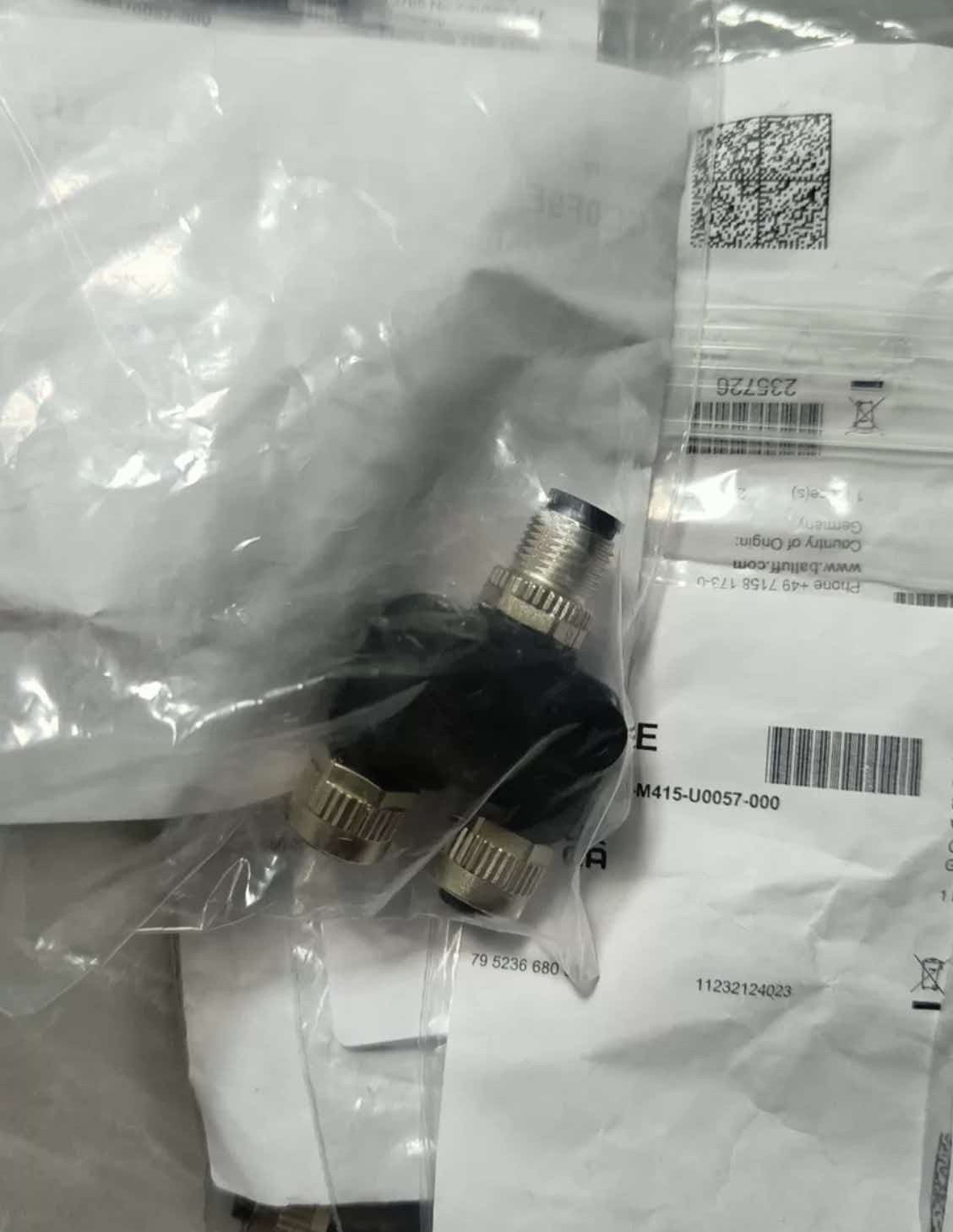
At a Glance. Factory identification questions divide into two kinds. One asks what is this object — which tool, which workpiece, which pallet. The other asks what state is this sensor in — which is really a networking question. The Balluff range covers both, and the two are frequently confused. BIS M-125 is a 13.56 MHz HF RFID read/write head for tool identification and workpiece tracking. BNI EIP-508-105-Z015 is an 8-port IO-Link master with EtherNet/IP. Everything sits in the Balluff stock, with sensors such as the BES M12 inductive sensor in limit switches and proximity sensors.
1. RFID identifies the object
An RFID system writes data to a tag attached to the tool, the workpiece carrier or the pallet, and reads it back when the tag enters the field. The information travels with the object, which is the key property: no database lookup is required to know what is on the fixture, and the record survives a power failure or a line restart.
The BIS M-125 operates at 13.56 MHz, the HF band. HF read/write heads are widely used for tool identification in machine tools and for workpiece tracking because they tolerate reasonable misalignment and do not require line of sight.
| Requirement | Why RFID suits it |
|---|---|
| Data must travel with the object | Written to the tag, read anywhere |
| Tool or fixture must not be mixed up | Unique tag per item, read on load |
| Harsh environment, no line of sight | Reads through contamination and non-metallic covers |
| Data must survive power loss | Stored on the tag, not only in the PLC |
| Several hundred read cycles per shift | Contactless, no wear mechanism |
2. IO-Link networks the sensors
IO-Link does not identify parts; it carries the configuration and diagnostics of the sensors themselves over a standard three-wire cable. A master such as the BNI EIP-508 connects up to eight IO-Link devices and presents them to the controller over EtherNet/IP, and it is field-mountable, which means the block can sit on the machine instead of in the cabinet.
What that buys a machine builder:
- Parameter sets travel with the device. Replacing a sensor downloads its configuration instead of requiring a manual teach.
- Diagnostics reach the PLC. Contamination, short circuits and out-of-range conditions are reported as data rather than as a missing signal.
- Fewer cables and shorter runs. A single field block replaces a bundle of individual cables back to the panel.
- Port-level visibility. Which port failed is known immediately, which shortens unplanned downtime.
3. Vision solves the remaining cases
Where the object carries no tag and cannot, and where identity must be established from appearance — a printed code, a label, a dimensional feature — a vision system is the answer. BVS-E is the Balluff machine vision entry in our stock, covering presence detection, code reading and dimensional inspection. Note that vision requires deliberate lighting and a stable presentation; it is not a drop-in substitute for RFID on a dirty fixture.
4. Decision guide
| Question | Answer |
|---|---|
| Does the object need identity that travels with it? | RFID read/write system |
| Is the requirement to configure and diagnose sensors remotely? | IO-Link master |
| Is identity printed on the part and cannot be tagged? | Vision or code reading |
| Is only presence, not identity, required? | Inductive or photoelectric sensor |
| Both identity and sensor diagnostics required? | RFID for the part, IO-Link for the sensors, on the same PROFINET or EtherNet/IP segment |
5. Specifying a system
- Read distance and field size. Set by the read head and the tag size together, not by the read head alone.
- Tag mounting. Metal around the tag changes the read behaviour; metal-mountable tags exist for that reason.
- Data volume. If production data is written to the tag, size the tag memory for the full record, not the identifier alone.
- Network protocol. The IO-Link master's backplane protocol must match the controller: EtherNet/IP and PROFINET versions are different articles.
- Environmental rating. Field-mounted blocks see washdown and coolant; confirm the IP rating and the connector type for the machine area concerned.
Send the object to be identified, the number of read points per cycle and the controller platform, and we will propose a matched read head, tag and field block combination from the Balluff range with a single quotation.