
In factory automation, the two most common non-contact detection technologies are the inductive proximity sensor and the photoelectric sensor. The choice is usually simple: inductive sensors detect metal at short range, while photoelectric sensors detect almost anything at longer range. This guide compares the Balluff BES and BOS families to help you choose.
At a Glance: The Short Answer
Choose the inductive (BES) sensor to detect metal targets at close range (1–40 mm) with high immunity to dirt and oil. Choose the photoelectric (BOS) sensor to detect non-metal or distant targets (up to tens of metres) where the object can be seen optically.
Side-by-Side Comparison
| Feature | Inductive (BES) | Photoelectric (BOS) |
|---|---|---|
| Detection principle | Eddy current on metal | Light beam (diffuse/retro/through) |
| Target material | Metal only | Any material |
| Range | 1–40 mm | Up to 10 m+ |
| Dirt / oil immunity | Excellent | Lens can be obscured |
| Cost | Lower | Higher |
When to Choose the Inductive Sensor (BES)
The Balluff BES inductive range is the workhorse for metal detection in harsh environments. Available in M12, M18 and M30 cylindrical form factors:
- BES M12 — compact sensor with 4 mm switching distance, PNP NO, 10–30 V DC. Ideal for tight machine spaces.
- BES M18 — mid-size sensor for general position sensing.
- BES M30 — larger body with longer sensing distance for heavy-duty applications.
Choose inductive when the target is metal and the environment is dirty, oily or subject to vibration — inductive sensors ignore almost everything except metal.
When to Choose the Photoelectric Sensor (BOS)
The BOS 18M Photoelectric Sensor is an M18 diffuse-reflective unit with a 100 mm range and background suppression. Choose photoelectric when:
- Your target is non-metal (plastic, wood, glass, liquid, labels).
- You need longer range (beyond a few tens of millimetres).
- You need to detect transparent or coloured objects (with the right sensing mode).
Beyond Simple Detection: The Full Balluff Ecosystem
Balluff extends beyond discrete sensors into identification, networking and vision:
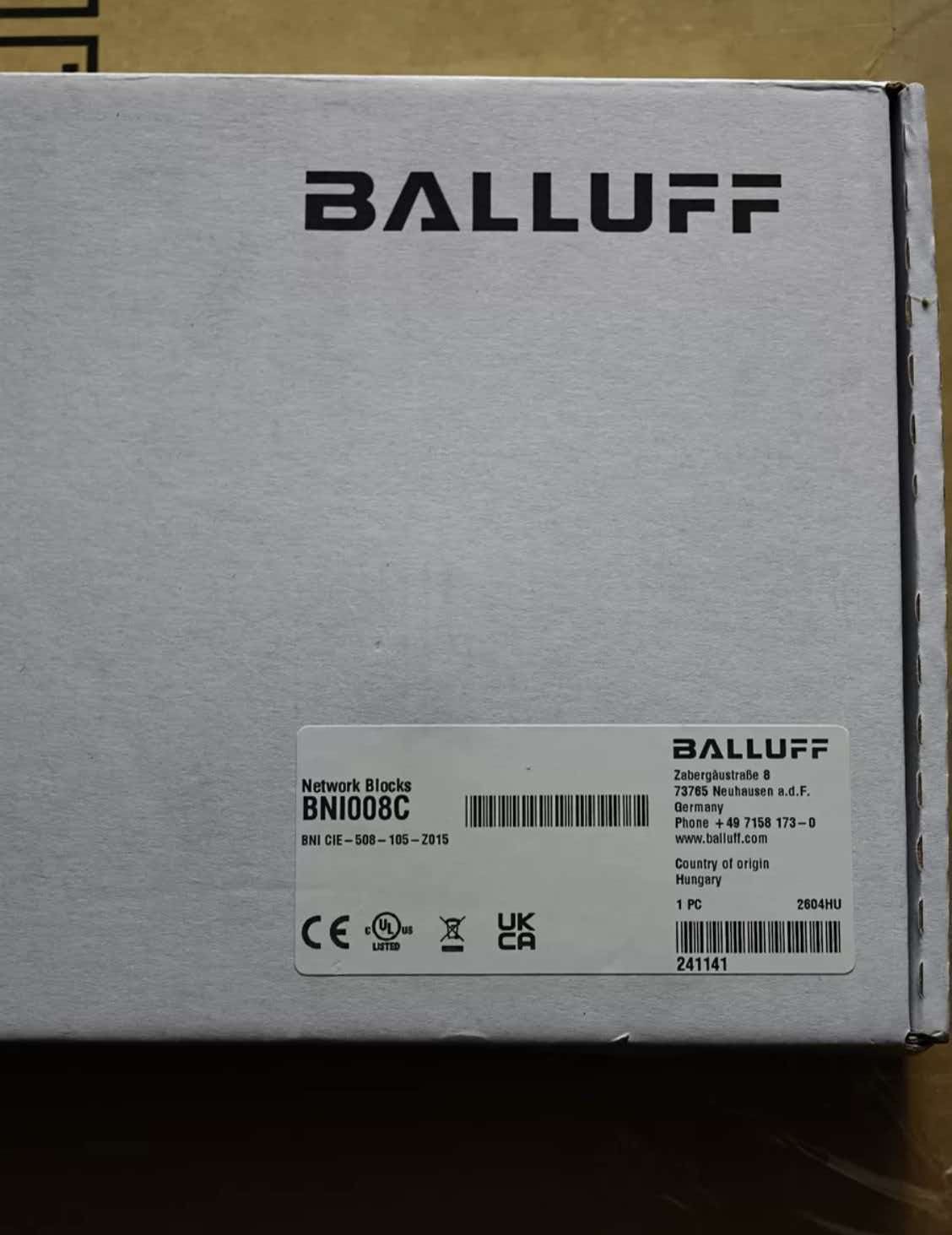
- BNI EIP-508 IO-Link Master — connects 8 IO-Link devices to EtherNet/IP, adding diagnostics and parameterisation.
- BIS M-125 RFID — 13.56 MHz HF read/write head for tool and workpiece identification.
- BTL5-S Linear Position Sensor — contactless linear measurement.
- BVS-E Machine Vision — compact vision sensor for presence detection and code reading.
Decision Guide
- Metal target, short range, dirty environment? → Inductive (BES M12/M18/M30).
- Non-metal or distant target? → Photoelectric (BOS 18M).
- Need diagnostics / parameterisation? → Add BNI EIP-508 IO-Link master.
- Need tool / part identification? → BIS M-125 RFID.
- Need presence + code reading? → BVS-E vision.
Get a Quote
Glorient supplies the complete Balluff range — BES inductive, BOS photoelectric, IO-Link masters, RFID and vision. Send us your target material, range and environment and we will recommend the correct sensor. Request a quotation and we will respond within 24 hours.