
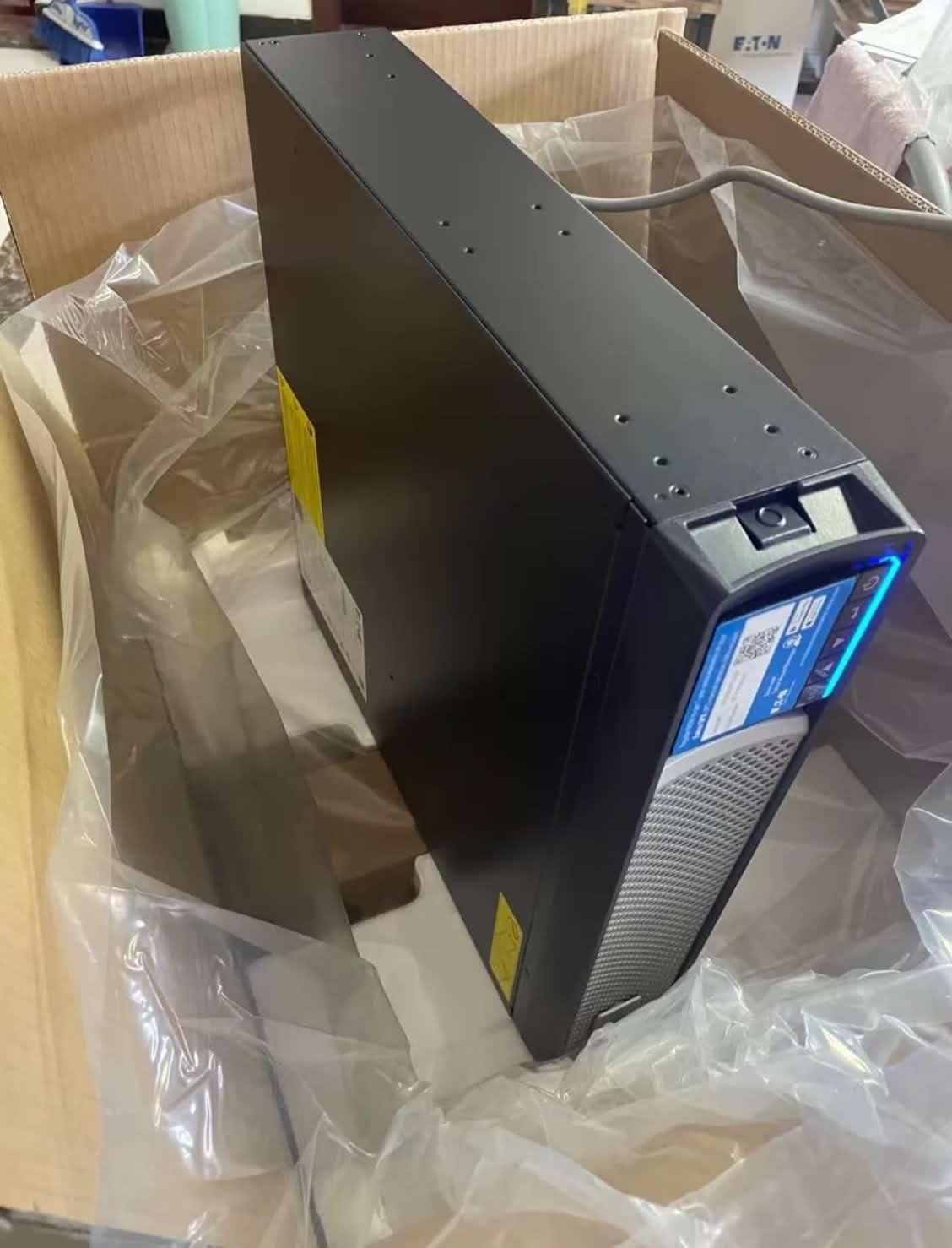
At a Glance. Two UPS systems with the same kVA rating can behave completely differently when the mains fails. The difference is the topology, and it is the first thing to fix before comparing brands or prices. Online double-conversion units such as Eaton 9SX1000I-AU and the larger Socomec MASTERYS IP+ 30 kVA regenerate the output continuously. Line-interactive units pass the mains through and only switch to inverter on failure. Our online UPS and line-interactive UPS categories show what is currently available.
1. The three topologies
| Topology | How the load is fed | Transfer time |
|---|---|---|
| Standby / offline | Direct from mains, inverter on failure | Several milliseconds |
| Line-interactive | Mains through an AVR, inverter on failure | A few milliseconds |
| Online double-conversion | Always from the inverter, mains only charges the battery | No transfer at all |
2. What online double-conversion actually buys you
The output of an online UPS is regenerated from DC. That means the load never sees the input waveform, and the following problems disappear from the load's point of view:
- Voltage sags and swells — corrected before they reach the load
- Frequency variation — the inverter sets the output frequency
- Harmonic distortion from other equipment — filtered by the rectifier and inverter stages
- Wide input window — the unit rides through input excursions that would force a line-interactive model to transfer to battery
That is why online units are specified for process control, medical equipment, industrial control cabinets and any load where a transfer event itself is a risk. The cost is efficiency: double conversion loses a few percent more than a line-interactive design running on mains.
3. When line-interactive is the better answer
For small IT loads, network switches, CCTV and general office equipment served by a reasonably stable supply, a line-interactive UPS is smaller, cheaper, more efficient and simpler to maintain. It is the wrong choice only when the load is sensitive to transfer time or to waveform quality.
| Load | Recommended topology |
|---|---|
| Industrial controller, DCS, process I/O | Online double-conversion |
| Server room, network core | Online double-conversion |
| Workstations, CCTV, small network closet | Line-interactive |
| Emergency lighting, general office | Line-interactive or standby |
| Long autonomy requirement | Online, with external battery bank sizing |
4. Sizing the unit
- Add real power, not nameplate VA. Sum the watts of the loads and apply a power factor for switch-mode supplies. A 1000 VA / 900 W unit such as 9SX1000I-AU is limited by whichever figure is reached first.
- Leave headroom. Planning to 70–80 percent of rated capacity gives room for inrush from motors and for future growth.
- Decide autonomy honestly. Runtime is set by the battery, not the UPS rating. Doubling runtime generally means a bigger battery bank, not a bigger UPS.
- Check the input. Single-phase and three-phase models are not interchangeable. Large industrial units such as MASTERYS IP+ 30 kVA 3/3 are three-phase in and three-phase out, and the electrical drawing must match.
- Plan the bypass. For critical loads an external maintenance bypass allows battery and electronics service without dropping the load.
5. Battery replacement is the real maintenance cost
Electronics in a UPS often outlive two or three battery sets. When specifying, confirm the battery type, the number of blocks and whether hot-swap is possible. For legacy units where the battery format is obsolete, send us the existing model and the label data — we regularly supply replacement batteries and complete UPS units for installed Eaton, Socomec and other industrial systems, and can cross-reference to a current model from our Eaton and Socomec stock.