
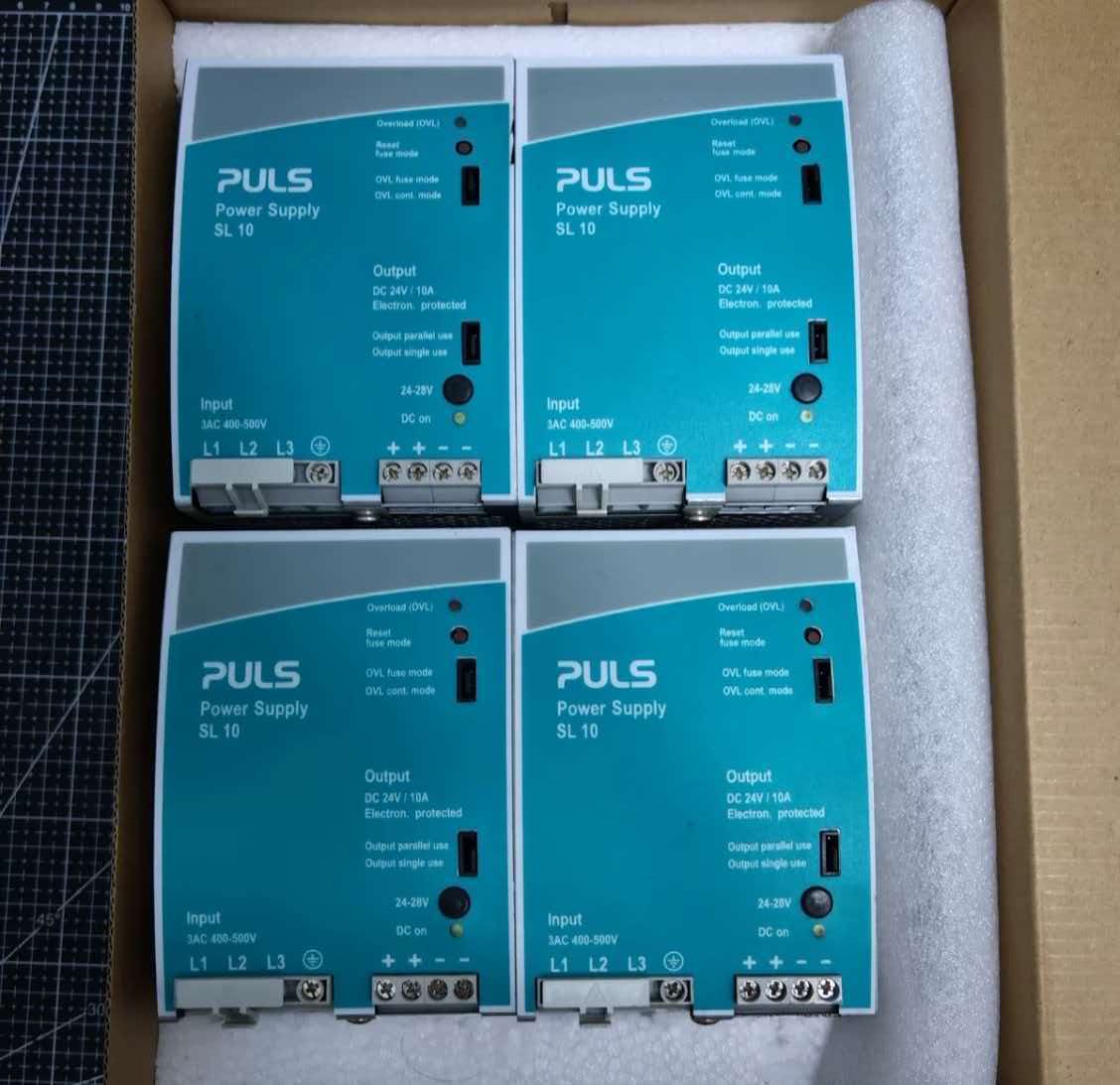
At a Glance. All three brands build excellent 24 V DIN rail power supplies, but they optimize for different things: PULS (DIMENSION, CP, ML, SL series) leads on efficiency and unit power density — its 240 W units fit in 39 mm housings and run at up to 95.5 % efficiency with continuous 20 % power reserve; Phoenix Contact QUINT POWER is the strongest ecosystem pick with SFB technology (6× rated current for 12 ms to trip breakers selectively) and NFC-configurable output characteristics; Weidmüller PROtop offers the highest single-unit power in the low-profile class (up to 1000 W) and a modular DC-UPS / redundancy extension system. If your priority is thermal performance and space on the rail, PULS wins; if your priority is breaker-selective protection and ecosystem breadth, QUINT wins; if your priority is raw watt per rail-inch plus modular backup, PROtop wins.
1. Brand Overview Table
| Aspect | PULS (DIMENSION / CP / ML) | Phoenix Contact (QUINT POWER) | Weidmüller (PROtop) |
|---|---|---|---|
| Country / HQ | Germany (Munich area) | Germany (Blomberg) | Germany (Detmold) |
| Flagship 24 V lines | DIMENSION, CP, ML, SL, FPS | QUINT POWER (1st / 2nd gen), QUINT4 | PROtop, PROtop2, PRO ECO |
| Single-phase power range | 15 W – 480 W | 36 W – 480 W | 45 W – 480 W (PROtop) |
| Three-phase power range | 240 W – 960 W | 240 W – 1000 W+ | 600 W – 1000 W |
| Peak efficiency (typical) | Up to 95.5 % | Up to 94.5 % | Up to 95.3 % |
| Continuous power reserve | Up to +20 % (PULS Power Reserve) | +25 % permanent (QUINT DYNAMIC BOOST on QUINT4) | +50 % short-term (PROtop boost) |
| Signature technology | Power Reserve, unit power density | SFB (6×In 12 ms), NFC config, preventive function monitoring | NEXT-level integration, DC-UPS modules |
| IO-Link / communication | Available (e.g. CP20.248-IOL) | QUINT4 with IO-Link / NFC | PROtop with optional communication module |
| Best for | Thermal-critical and space-critical panels | Ecosystem projects needing breaker-selective trips | High-wattage single units + modular backup |
2. Technology Deep-Dive
2.1 PULS — Power Reserve and Power Density
PULS focuses exclusively on power supplies, and it shows in the mechanical design. A CP5.241 (24 V / 5 A, 120 W) occupies just 32 mm of rail width, while the CP20.248-IOL delivers 24 V / 20 A in a 48 mm housing with IO-Link diagnostics for predictive maintenance. PULS units ship with a permanent +20 % power reserve, so a 240 W unit runs continuously at 288 W — useful for motor start and inrush. Thermal design is best-in-class, which matters in sealed cabinets.
2.2 Phoenix Contact QUINT — SFB and Ecosystem
The QUINT POWER signature is SFB Technology (Selective Fuse Breaking): the unit pushes up to 6× rated current for 12 ms, enough to trip a downstream miniature circuit breaker selectively instead of the whole panel dropping out on a single branch fault. The QUINT4 generation adds NFC configuration (output curve, thresholds) and preventive function monitoring that reports degradation before failure. Phoenix's breadth — relays, terminals, controllers — makes QUINT the default in Phoenix-centric panels.
2.3 Weidmüller PROtop — Power and Modular Backup
PROtop targets the high-wattage end: single units up to 1000 W in a low-profile housing, with up to +50 % short-term boost. The differentiator is the NEXT-level extension system: the same form-factor accepts plug-in DC-UPS capacitive modules and redundancy modules, so you can build a buffered, redundant 24 V system without external accessories. For cabinet builders standardizing on one mechanical family, this simplifies BOM and spares.
3. Decision Guide — Which Brand for Which Panel?
- Sealed / fanless cabinet, ambient 60 °C+, thermal headroom tight? → PULS (highest efficiency = lowest self-heating; e.g. PIC120.241D for 120 W at 24 V).
- Rail space premium (retrofit into existing panel)? → PULS CP series — CP5.241 (32 mm) or CP20.248-IOL (48 mm).
- Panel with many MCB-protected branches; a branch fault must not drop the bus? → Phoenix QUINT with SFB.
- Need parameter profiles pushed via NFC / phone app? → QUINT4.
- Single unit > 500 W, or planning a DC-UPS / N+1 later? → Weidmüller PROtop + extension modules.
- DC/DC conversion (48 V → 5 V logic, 24 V → 48 V radio)? → PULS ML series — ML15.051 (5 V / 3 A, NEC Class 2) or ML50.105 (48–56 V / 1.1 A).
- 12 / 15 V legacy loads? → PIM60.121 (12–15 V / 5 A, 60 W).
- Field / remote installation power (IP-rated enclosure)? → FPS300.246-049-102 field power supply.
- 48 V telecom / PoE bus? → SL10.305 (48–52 V / 5 A).
4. Efficiency and Thermal — Why It Matters
At 24 V / 10 A (240 W) continuous load, a 1-percentage-point efficiency difference equals ~2.5 W of additional heat inside the cabinet — roughly 20 kWh per year of continuous operation, and more important, faster electrolytic-capacitor ageing. PULS's 95 %+ efficiency on mid-range units typically gives 30–50 % longer service life (MTBF calculated at 40 °C ambient) compared with older-generation units. All three brands publish full load/temperature derating curves; when comparing, always read the derating at your ambient, not the nominal 25 °C figure.
5. Quick FAQ
Q: Are PULS and Phoenix Contact units interchangeable on the rail?
Mechanically yes — both use TS35 DIN rail and similar terminal layout. Electrically, verify output curve and reserve characteristics match your load's inrush profile.
Q: Does QUINT SFB trip any breaker?
SFB is tuned for common MCB characteristics (B / C trip curves); check Phoenix's SFB coordination tables for your specific breaker part number.
Q: Can PROtop's DC-UPS module replace a battery bank?
For short bridging (seconds), yes — capacitive modules cover ride-through for safe shutdown, not extended autonomy.
Q: Which brand has the longest warranty?
All three offer 5-year typical warranties; PULS extends to 10 years on some DIMENSION units. Verify per model.
6. Popular PULS Units in Stock at Glorient
- PULS CP20.248-IOL — 24 V / 20 A, 48 mm, IO-Link diagnostics.
- PULS PIC120.241D — 24 V / 5 A, 120 W, coated PCB option.
- PULS CP5.241 — 24 V / 5 A in 32 mm width.
- PULS PIM60.121 — 12–15 V / 5 A, 60 W.
- PULS FPS300.246-049-102 — 300 W field power supply.
- PULS SL10.305 — 48–52 V / 5 A for telecom loads.
- PULS ML50.105 — DC/DC converter, 48–56 V / 1.1 A.
- PULS ML15.051 — DC/DC converter, 5 V / 3 A, NEC Class 2.
Not sure which DIN rail power supply fits your panel? Send us your load list (voltage, current, inrush, ambient) and our engineers will cross-reference PULS, Phoenix Contact and Weidmüller options with pricing and lead time.