
At a Glance. Choosing a 24 V DIN rail power supply is a six-step exercise: (1) sum your load current including inrush, (2) pick a topology (most industrial panels want an isolated AC/DC switch-mode PSU), (3) size with 20–30 % headroom and respect the manufacturer's derating curve at your panel's ambient, (4) choose a PSU with permanent Power Reserve if you have motor / valve inrush, (5) add redundancy and DC-UPS if a power dip would stop a process or lose data, and (6) verify approvals (UL / CE / RCM, and ATEX or Class I Div 2 if the cabinet is in a hazardous area). This guide walks each step and ends with a worked sizing example.
1. Step-by-Step Sizing Procedure
Step 1 — Sum the Load (Continuous + Peak)
List every DC load on the 24 V bus, including PLCs, I/O blocks, HMIs, sensors, actuators, valves and relays. For each, capture the continuous current and the peak / inrush current (motors, solenoids, capacitive loads). Add all continuous currents to get the steady-state demand. The peak is what determines whether you need a PSU with permanent Power Reserve or a peak boost mode.
Step 2 — Choose Topology
| Topology | Use when | Avoid when |
|---|---|---|
| AC/DC switch-mode (DIN rail PSU) | Mains-powered cabinet, any industrial load | RF-sensitive analog circuits (use a linear post-regulator) |
| DC/DC converter (e.g. PULS ML) | Bus 24 V → sub-rail 5 V / 12 V / 48 V logic; vehicle 12/24 V | Single-rail mains-fed panel (use AC/DC directly) |
| Linear regulator | Ultra-low noise analog, RF, precision sensors | High current (low efficiency, hot) |
| Three-phase PSU | High power > 480 W, balanced load | Single-phase mains only |
Step 3 — Size with Headroom and Respect Derating
Rule of thumb: PSU rated current = 1.2 × continuous load for general use, or 1.3–1.5 × if you have heavy inrush and no Power Reserve. Then check the derating curve at your real ambient. Most DIN rail PSUs are rated at 25 °C with a derating of 2–4 W/°C above 40–50 °C. A 240 W PSU at 60 °C ambient may only deliver 180 W — always read the curve.
Step 4 — Power Reserve vs SFB vs Boost
| Feature | Vendor implementation | What it gives you |
|---|---|---|
| Power Reserve (continuous) | PULS DIMENSION / CP / PIC series | +20 % permanent extra capacity — covers motor / valve inrush without derating |
| SFB Technology (12 ms pulse) | Phoenix Contact QUINT | 6× rated current pulse to selectively trip downstream MCBs |
| DYNAMIC BOOST | QUINT4 | Up to +25 % continuous, 5 s for peak loads |
| Peak Power Boost | Weidmüller PROtop | +50 % short-term for capacitive loads |
Step 5 — Redundancy and DC-UPS
For non-stop processes, use two PSUs in parallel with a redundancy module (MOSFET-OR diode) so a single PSU failure does not drop the bus. For ride-through of brief mains interruptions (seconds to minutes), add a DC-UPS module with capacitive or battery buffer. Long autonomy (> 30 min) needs a battery cabinet and a charger module.
Step 6 — Approvals and Environmental
- General industrial: CE, UL 508 / UL 60950-1, RCM.
- Hazardous area: ATEX II 3G (zone 2) or Class I Div 2 for cabinets near flammable atmospheres.
- Outdoor / harsh: conformal coating (look for "D" or "-C" suffix, e.g. PIC120.241D).
- Railway / rolling stock: EN 50155, EN 50121-4 (specific PULS models qualify).
- NEC Class 2: required when feeding Class 2 circuits (US), e.g. ML15.051 is Class 2 compliant.
2. Worked Example — 10 A Continuous Load
A control cabinet has a PLC (0.8 A), 6 × I/O blocks (1.2 A total), an HMI (1.5 A), 4 × proportional valves with inrush (peak 6 A, continuous 1 A), and instrumentation (0.5 A). Continuous sum = 0.8 + 1.2 + 1.5 + 1.0 + 0.5 = 5 A continuous. Peak = 5 A + 5 A valve inrush ≈ 10 A peak.
Apply 1.3× headroom for inrush and Power Reserve demand → 5 A × 1.3 = 6.5 A minimum continuous. To stay comfortable and avoid over-dimensioning, pick a 24 V / 10 A (240 W) PSU. Options:
- PULS CP20.248-IOL — 24 V / 20 A in 48 mm, with IO-Link for current / temperature monitoring.
- Phoenix QUINT24/20 with SFB — same power class, NFC-configurable.
- Weidmüller PROtop 24 V / 10 A — same class with optional DC-UPS module.
For redundancy, add a second identical PSU + a redundancy module. For ride-through, add a DC-UPS (e.g. PULS UB10.241 or Weidmüller NEXT-DC-UPS).
3. Common Sizing Mistakes to Avoid
- Ignoring inrush — proportional valves, contactors and DC motors can pull 5–10× their rated current at switch-on. A PSU without Power Reserve will trip or fold back.
- Forgetting derating — a 240 W PSU at 60 °C may only deliver 180 W. Always read the curve at your real ambient.
- Mismatched breakers — standard MCBs trip at 1.13–1.45× rated; without SFB or proper coordination, a branch fault can drop the whole 24 V bus.
- Single PSU for safety-critical loads — any single PSU is a single point of failure; for safety circuits, use redundant or buffered supply.
- Wrong DC-UPS chemistry — for ride-through seconds, use capacitive buffers; for minutes / hours, use battery (VRLA or LiFePO4).
4. Decision Guide — Which PSU for Which Cabinet
- Compact control cabinet, < 5 A continuous? → PULS CP5.241 (24 V / 5 A in 32 mm).
- Mid-size panel with valves, 5–10 A continuous? → PULS CP20.248-IOL (24 V / 20 A, IO-Link).
- 120 W industrial load, harsh / outdoor? → PULS PIC120.241D (coated PCB, 24 V / 5 A).
- Logic rail 5 V from 24 V bus? → PULS ML15.051 (DC/DC 5 V / 3 A, NEC Class 2).
- 48 V / 56 V radio / telecom sub-rail? → PULS ML50.105 (DC/DC 48–56 V / 1.1 A).
- Field / outdoor enclosure, 300 W class? → PULS FPS300.246-049-102.
- 48 V PoE / bus for telecom? → PULS SL10.305.
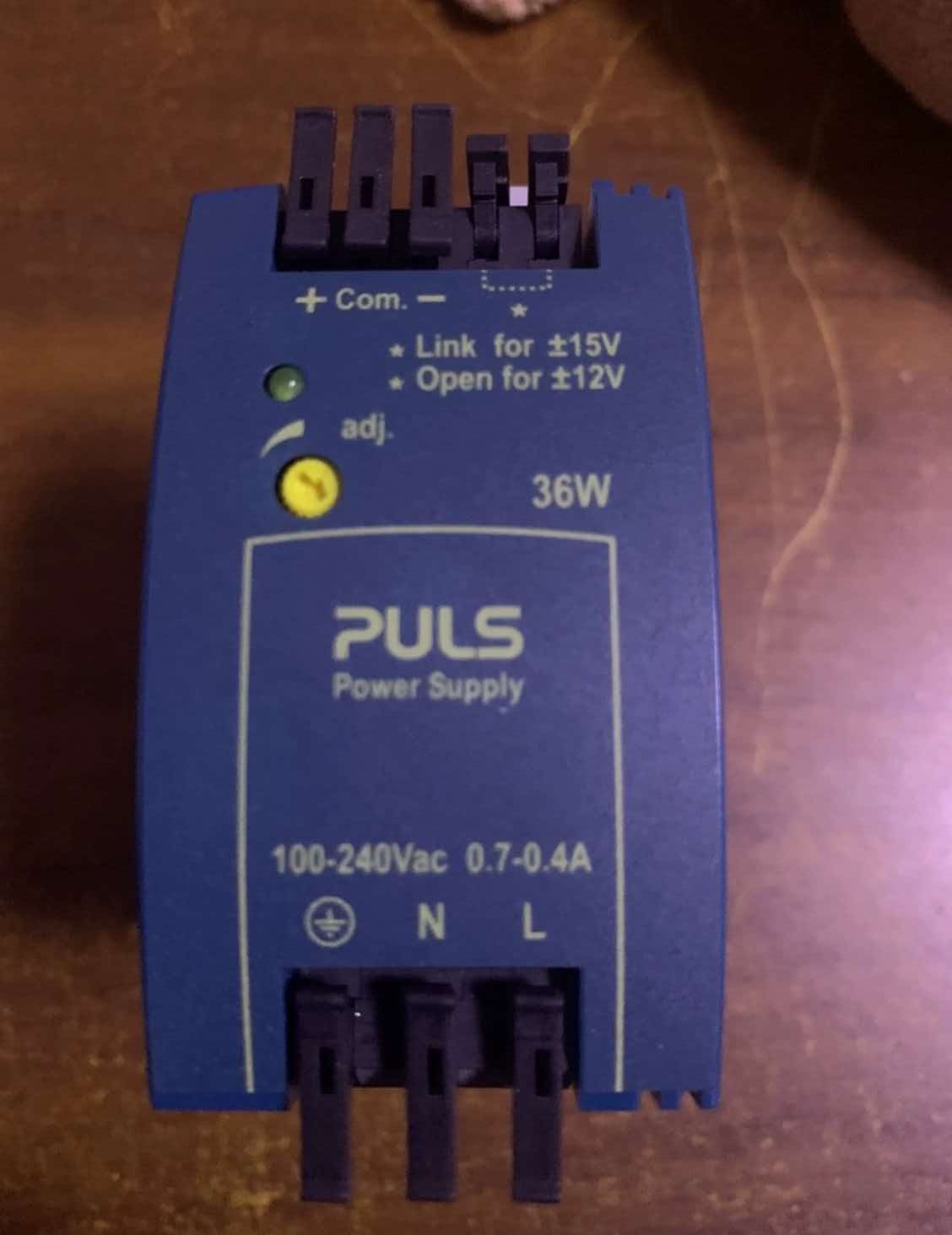
- Legacy 12 / 15 V loads (e.g. old control boards)? → PULS PIM60.121 (12–15 V / 5 A).
5. Quick FAQ
Q: Can I run two PSUs in parallel without a redundancy module?
Technically yes, but they will not share load perfectly; one may carry 70 % and fail prematurely. Use a MOSFET-OR redundancy module for clean load sharing.
Q: How long does a DC-UPS hold up a 5 A load?
A 1 kJ capacitive buffer holds ~10 s at 5 A. A 7 Ah VRLA battery with charger holds ~30 min depending on Peukert derating.
Q: Is 95 % efficiency really worth paying more?
At 240 W continuous, the 2 % efficiency gap is ~5 W of heat — 30–50 % longer capacitor life in a sealed cabinet. It usually pays back in extended maintenance intervals.
Q: NEC Class 2 — when do I need it?
When your 24 V branches feed Class 2 wiring (US / Canada); Class 2 limits energy to 100 VA / 5 A. PULS ML15.051 is Class 2 compliant out of the box.
6. Related Products in Stock at Glorient
- PULS CP20.248-IOL — 24 V / 20 A, 48 mm, IO-Link.
- PULS PIC120.241D — 24 V / 5 A, coated for harsh environments.
- PULS CP5.241 — 24 V / 5 A in 32 mm width.
- PULS PIM60.121 — 12–15 V / 5 A, 60 W.
- PULS FPS300.246-049-102 — 300 W field power supply.
- PULS SL10.305 — 48–52 V / 5 A for telecom / PoE.
- PULS ML50.105 — DC/DC 48–56 V / 1.1 A.
- PULS ML15.051 — DC/DC 5 V / 3 A, NEC Class 2.
Need help sizing a 24 V PSU for your cabinet — including redundancy and DC-UPS architecture? Send us your load list (continuous current, peak inrush, ambient, approvals needed); our engineers will return a complete BOM with PULS, Phoenix Contact and Weidmüller options.