
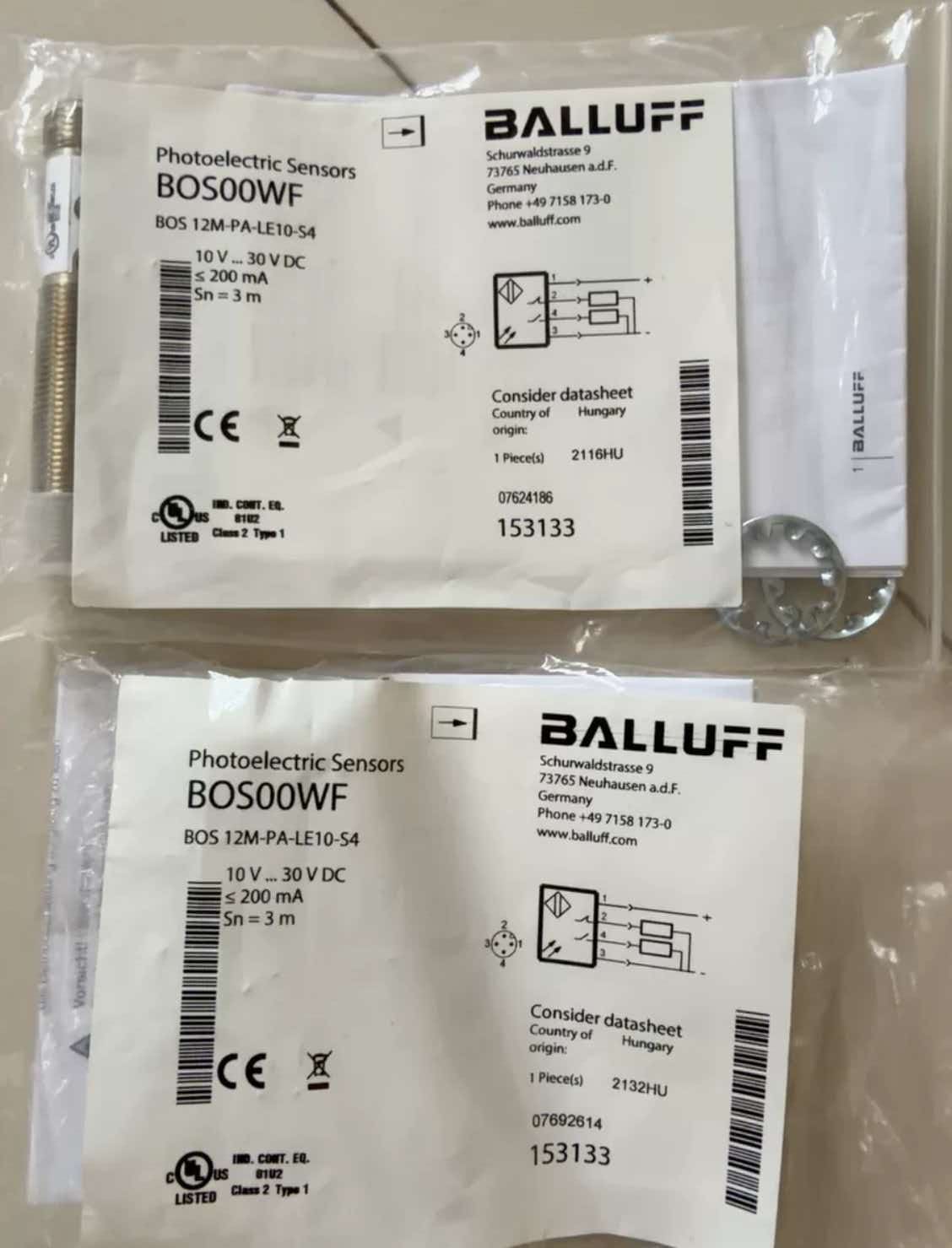
At a Glance. The Balluff BES inductive family and the BOS 18M photoelectric sensor answer one question differently: what is the target? Inductive sensors detect metal only, at short range (4-15 mm depending on size), with total immunity to dust, oil and moisture — and at the lowest cost per point. Photoelectric sensors detect any material that reflects light, at far longer range (the BOS 18M reads 100 mm diffuse, far more with reflector variants), but their optical path is affected by heavy soiling. The rule: metal target, dirty environment, position sensing → BES; non-metal target, longer distance, presence checking → BOS.
1. Head-to-Head Specification Table
| Specification | BES M12 / M18 / M30 (inductive) | BOS 18M (photoelectric) |
|---|---|---|
| Detection principle | Eddy-current loss (metal targets only) | Light reflection (any material) |
| Switching distance | 4 mm (M12) / 8 mm (M18) / 15 mm (M30), flush | 100 mm diffuse, background suppression |
| Target material | Metals (steel standard) | Any (metal, plastic, wood, liquid, cardboard) |
| Environment tolerance | Dust, oil, chips, moisture — unaffected | Lens soiling degrades range; needs cleaner air |
| Output | PNP NO, 10-30 VDC | PNP NO |
| Housing | M12 / M18 / M30 brass cylinder | M18-style rectangular head |
| Connector | M12 4-pin | M12 4-pin |
| Protection | IP67 | IP67 |
| Relative cost | Lowest | Moderate |
| Stock pages | BES M12 / M18 / M30 | BOS 18M |
2. Choosing the BES Size: M12 vs M18 vs M30
Within the inductive family, housing size sets the switching distance and mechanical budget:
- BES M12 (4 mm flush): tight machine slots, small metal targets, compact OEM equipment;
- BES M18 (8 mm flush): the industrial default — standard drillings, best availability of brackets;
- BES M30 (15 mm flush): maximum distance and robustness for heavy machinery and material handling.
All three share the same PNP NO, 10-30 VDC and M12 4-pin interface, so upsizing later is a plug-compatible swap — the usual reason to start with M18 and only shrink when space forces it.
3. When the Photoelectric Wins
The BOS 18M earns its place in three situations:
- Non-metal targets: cartons, plastic totes, glass, liquids — invisible to inductive technology by physics;
- Distance: 100 mm diffuse with background suppression (ignoring conveyor background), versus a 15 mm inductive ceiling;
- Small or low-contrast objects at defined positions, where the suppression function prevents false triggers from machine backgrounds.
Beyond point sensing, Balluff's portfolio extends the same M12-connector ecosystem upward: the BNI EIP-508 IO-Link master (8 ports, EtherNet/IP, IP67 field mount) adds remote diagnostics and parameterization; the BIS M-125 HF RFID head (100 mm, IO-Link) handles tool and workpiece identification; the BTL5-S magnetostrictive transducer covers linear position to 4 m at ±50 µm; and the BVS-E vision sensor takes over when the task needs code reading or shape verification rather than a single switching point.
4. Selection Summary
| Your task | Recommended sensor |
|---|---|
| Metal target, dusty/oily environment, position or end-stop | BES M12 / M18 / M30 by distance need |
| Non-metal target (carton, plastic, liquid level presence) | BOS 18M |
| Detection beyond 100 mm or against backgrounds | BOS 18M with suppression |
| Tool / workpiece identification | BIS M-125 RFID |
| Continuous position 0-4 m | BTL5-S |
| Code reading / shape verification | BVS-E |
| Networking 8 sensors with diagnostics | BNI EIP-508 IO-Link master |
5. Replacement and Cross-Reference
Common replacement patterns:
- Legacy M12/M18/M30 inductives from other brands: the BES series is dimensionally and electrically plug-compatible (same thread, PNP NO, M12 4-pin) — match switching distance and flush/non-flush mounting from the old nameplate.
- Photoelectric swaps: when replacing a failed diffuse sensor, confirm range class and whether background suppression is required; the BOS 18M covers the standard 100 mm diffuse class.
Send Glorient the failed sensor's model or a photo of the nameplate and we will return the closest in-stock Balluff equivalent within one business day.
6. FAQ
Can an inductive sensor detect plastic or liquid?
No — inductive technology only responds to metals. For plastic, wood, cardboard or liquids use a photoelectric sensor such as the BOS 18M, or a capacitive variant for direct liquid contact.
Why choose the BES M12 when the M30 reaches further?
Distance is set by coil size: the M12's 4 mm flush range is the price of fitting into compact machine slots. If space allows, the M18 is the standard choice — same connector, longer range, most bracket options.
What does background suppression do on the BOS 18M?
It ignores reflections from objects behind the set distance (conveyor frames, machine walls), so the sensor switches only on the target — the key feature for reliable detection on moving conveyors.
Need a quote? Browse in-stock Balluff sensors — inductive, photoelectric, RFID, IO-Link and vision — or send your sensor list for a same-week quotation.