
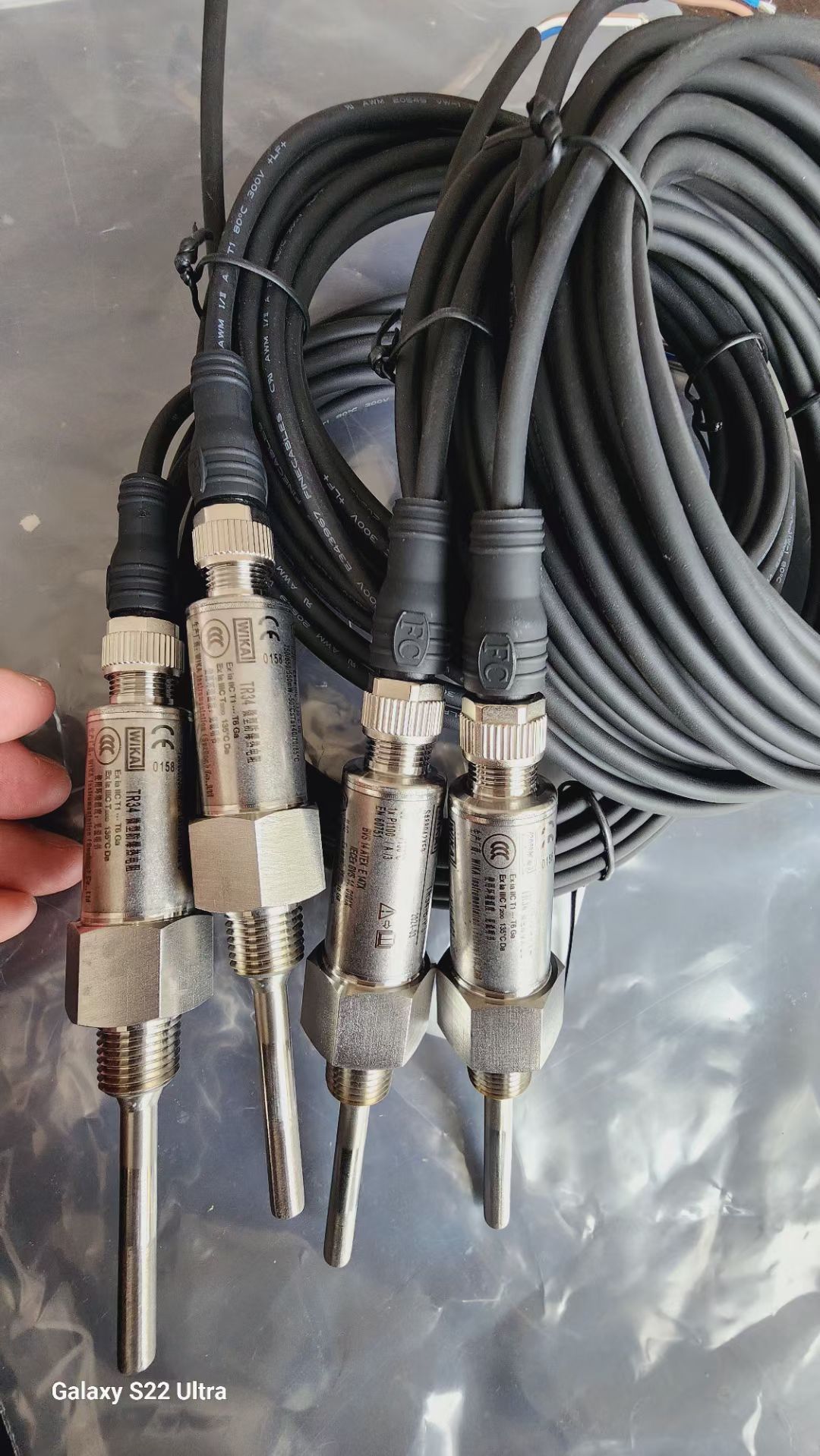
At a Glance. A conventional pressure gauge cannot tell you whether an SF6 switchgear compartment is safe, because the pressure inside it rises and falls with the ambient temperature even when no gas has escaped. What matters is gas density, and every instrument in the WIKA SF6 range exists to derive it. This guide covers the 43 items listed under SF6 gas products: the analogue GDM and GDI density monitors, the digital GD-20 and GDT-20 sensor families, the GA11 quality analyser, the GA35, GIR-10 and GPD-1000 detection instruments, the GPU service platform, and the GLTC, GCx and GCH connection parts that decide whether any of it can be recalibrated without dismantling the plant.
1. Why Density Is Measured and Not Pressure
In a sealed compartment, the amount of gas present is fixed. Its pressure follows the gas laws, so a tank that reads 6 bar at 20 °C will read noticeably higher at 40 °C with exactly the same quantity of gas inside it. A pressure gauge therefore reports ambient weather, not insulation condition. Density — mass per unit volume — is the quantity that stays constant when nothing has leaked, which is why IEC switchgear practice and every utility specification is written around density limits and not pressure limits.
Every WIKA instrument in this category solves that problem differently. Mechanical instruments compensate a Bourdon tube against a sealed reference volume so that the pointer reads the pressure standardised to 20 °C. Electronic instruments measure pressure and temperature separately and calculate density in a microprocessor using a virial equation. Both approaches reach the same answer; the choice between them is about whether you need a dial on the tank, a signal in a SCADA system, or both.
The stakes are practical as well as technical. SF6 has the highest global warming potential of the gases named in the Kyoto Protocol, and EU Regulation No 517/2014 on fluorinated greenhouse gases imposes checking and documentation duties on operators. That is why several instruments here are explicitly described as supporting functional checks and recalibration without dismounting. Given the global shift away from SF6, most of this range is also specified as prepared for alternative gases — a detail worth confirming at order stage rather than discovering at retrofit.
2. Analogue Density Monitors: GDM and GDI
The mechanical instruments divide into two families that are easy to confuse. The GDM family are gas density monitors: they display density and carry alarm contacts, so they can both inform an operator and trigger an interlock. The GDI family are gas density indicators: they display, and in the analogue versions they do not switch. Selecting a GDI where an alarm is required is one of the most common specification errors in this category.
The GDM-100 is the general-purpose monitor for medium and high-voltage equipment, with a local display and switch contact, temperature compensation, and hermetic sealing so that ambient temperature swings, differences in altitude and atmospheric pressure fluctuations have no effect on the reading. Its test connection is welded to prevent leakage, and functional checks or recalibration can be carried out without dismounting the instrument, in line with EU Regulation No 517/2014. Compensation for gas mixtures is available, which matters if the same instrument type is deployed across an SF6 and alternative-gas fleet.
The GDM-RC-100 is the high-voltage reference-chamber version. Instead of a simple compensated element it works on the reference gas principle: a welded reference gas volume gives an accurate isochore, temperature-compensated switch and display across the entire temperature range. It adds self-diagnostics and a complete local display of both the density and the vacuum range on a 100 mm dial — the vacuum indication being useful during evacuation and commissioning. The welded reference volume is also the reason WIKA quotes very high long-term stability for this model.
On the indication side, the GDI-100 covers medium and high-voltage equipment with a 100 mm dial, and its smaller sibling covers medium voltage only. Both display pressure standardised to 20 °C, are temperature-compensated and hermetically sealed in stainless steel, and are traceable by serial number. Where a precise digital readout is needed for verification work rather than permanent installation, the GDI-100-D adds a high-precision display with a logger capturing up to three measured values per second and wireless data exchange — the instrument for confirming that an installed monitor is still telling the truth.
| Model | Type | Voltage level | Switching | Distinguishing feature |
|---|---|---|---|---|
| GDM-063 / GDM-100 | monitor | medium and high | alarm contacts | welded test connection, gas-mixture compensation |
| GDM-RC-100 | monitor | high | isochore switching | reference gas chamber, self-diagnostics |
| GDI-063 | indicator | medium | none | 63 mm dial, stainless steel case |
| GDI-100 | indicator | medium and high | none | 100 mm dial, mixture compensation |
| GDI-100-D | digital indicator | medium and high | none | logger at 3 values per second, wireless |
Reference chamber or gas-filled: how to choose
A reference-chamber instrument carries its own sealed gas volume and therefore compares the compartment against a physical reference whose behaviour is known. That makes the switching accuracy independent of atmospheric pressure and altitude, and it is the correct choice for high-voltage equipment where a spurious or late alarm is expensive. A simpler gas-filled design is adequate for medium-voltage ring main units, which is exactly the split the range reflects: GDM-063 and the GDI-063 for medium voltage, GDM-RC-100 and the reference-chamber switch for high voltage.
Dial size is not cosmetic
The 63 mm and 100 mm designations describe the case diameter, and they change what the instrument can show. A 100 mm dial has room for both the density scale and the vacuum range, which matters during evacuation and refilling; a 63 mm dial shows density only. On a crowded ring main unit the smaller case is often the only one that fits, so the dial size is frequently decided by the enclosure rather than by the specification.
3. Digital Density Sensors and Transmitters: GD-20, GDT-20, GD-20-W
Digital sensors replace the compensated mechanical element with two measurements and a calculation. Each device measures pressure and temperature, then computes density in a microprocessor using a complex virial equation, which is substantially more accurate over a wide temperature range than any mechanical compensation. They also deliver the value as a signal, which is what makes condition-based monitoring possible rather than merely local inspection.
The GD-20 is the general-purpose density sensor for insulating gases, permanently monitoring a closed tank and reporting density, temperature and pressure. It offers a choice of output: Modbus RTU on RS-485, or analogue 4 … 20 mA. Ingress protection is IP67, with an optional field case rated to IP6k9k for washdown or harsh outdoor duty. Because the calculation is done in software, the same hardware can be configured for alternative insulating gases and even for measuring non-corrosive media such as transformer oil.
The GDT-20 is the transmitter variant for continuous monitoring of gas state parameters in sealed compartments, indoor and outdoor. It uses the same multi-sensor approach and RS-485 Modbus output protocol at IP65, with a stated emphasis on long-term stability and EMC characteristics — the latter matter because these devices sit inside the electromagnetic environment of switchgear. Compact dimensions allow installation where a dial instrument cannot be fitted.
The GD-20-W answers a different problem: how to instrument a compartment that has no signal wiring. It reports over wireless LoRaWAN with long battery life, keeping the same high-accuracy sensor technology and EMC behaviour in a very compact body. For retrofit projects and for older installations where cable routes no longer exist, wireless is often the only economically viable route to continuous monitoring, and it pairs naturally with the Modbus-based units used on new-build panels.
| Model | Output | Protection | Best for |
|---|---|---|---|
| GD-20 | Modbus RTU or 4 … 20 mA | IP67, optional IP6k9k case | general density, temperature and pressure |
| GDT-20 | Modbus RTU on RS-485 | IP65 | continuous monitoring, indoor and outdoor |
| GD-20-W | LoRaWAN wireless | compact, battery powered | retrofit without signal cabling |
Modbus, 4 … 20 mA or wireless
The choice is decided by the control system, not the sensor. Modbus RTU carries pressure, temperature and density as separate digital values on one RS-485 segment, which is what a modern SCADA or IEC 61850 gateway expects and what makes remote diagnostics possible. The 4 … 20 mA option deliberately transmits a single analogue value — either the absolute pressure at 20 °C or the density in g/l — and is the right answer when the receiving device is a legacy RTU with an analogue input card. LoRaWAN suits installations where neither is available.
4. Density Switches Without a Dial: GDS
Not every compartment needs a display. A density switch raises an alarm when density falls to a defined limit and nothing more, which is enough for many medium-voltage installations. The behaviour that distinguishes a good switch from a mediocre one is its independence from ambient conditions.
The GDS-MV for medium-voltage equipment is specified as independent of atmospheric pressure and altitude, and as requiring no recalibration — a straightforward statement that the element is sealed tightly enough that its zero point cannot drift with weather. It is aimed squarely at ring main units. The GDS-RC-HV serves high voltage on the reference-chamber principle, giving accurate isochore temperature-compensated switching across the whole temperature range, with self-diagnostics and the same welded reference gas volume that gives the equivalent monitor its long-term stability.
For both, and for the monitors above, the practical issue is not the switch but the means of testing it. A density switch that cannot be isolated from the compartment cannot be checked without interrupting supply, which is why the calibration valves in section 8 matter as much as the instruments they serve.
5. Gas Quality Analysis: The GA11 Analyser
Density tells you how much gas is in the compartment. It says nothing about whether the gas is still fit to insulate. After arcing, switching operations or a fault, SF6 decomposes into products that erode insulation performance and attack materials, and moisture entering during service does the same. Quality analysis is therefore a separate discipline with its own instrument.
The GA11 is WIKA's analyser for determining the quality of insulating gases. Depending on the equipment version it can measure the concentration of up to six substances, covering moisture, gas composition and purity, and decomposition products. Two design decisions make it practical rather than merely capable. First, measurement is decided intelligently from stability criteria in the sensor technology with temperature compensation, so the instrument reports when the reading has settled rather than forcing the operator to judge. Second, it carries no transport restrictions under IATA rules, which means it can be shipped or flown as ordinary equipment instead of being handled as dangerous goods.
Critically, the GA11 analyses not only SF6 but also C4-FN gas mixtures and gases of natural origin such as nitrogen, oxygen and carbon dioxide based mixtures. For utilities that have begun deploying SF6-free switchgear while still operating SF6 assets, that single capability avoids buying two analysers and two sets of calibration gases. A 10-inch colour touchscreen with a structured menu keeps operation consistent across a service team.
6. Ambient Monitoring and Leak Detection: GA35, GIR-10, GPD-1000
SF6 is roughly five times heavier than air. In a confined space — a substation basement, a cable trench, a GIS hall — a leak does not disperse upwards. It settles, displacing the air people need to breathe and creating an asphyxiation hazard before any electrical problem appears. Two of the instruments in this category exist purely to prevent that.
The GA35 monitors SF6 concentration in ambient air in enclosed spaces, covering an area up to 250 m² per unit. It is specified as sensitive only to SF6 and unaffected by humidity and common volatile organic compounds — the cross-sensitivity that makes cheaper gas monitors unusable in real substations, where solvents, lubricants and cleaning agents are always present. Response is short and measurement is continuous, with a 4 … 20 mA output for integration into a distributed control system and password-protected settings to prevent unauthorised adjustment. This is a fixed installation, not a hand tool: it protects a room, continuously, whether or not anyone is working in it.
Finding the leak is a different job from detecting its consequences, and it is done with portable instruments. The GIR-10 uses non-dispersive infrared technology to detect concentrations down to 0.6 ppmv, responding only to SF6 and therefore sharing the GA35's immunity to humidity and VOCs. It locates and quantifies leakages and can determine the leak rate for final inspection of gas-filled equipment, with factory calibration against certified test gases. Where a simpler go/no-go tool is adequate, the GPD-1000 gas detector offers two sensitivity levels set by a double click, an automatic switch-off to preserve battery, and a visible and audible low-battery warning so that a false reading is never mistaken for a clean one.
| Model | Role | Sensitivity | Output / form |
|---|---|---|---|
| GA35 | ambient room monitoring | SF6-specific, up to 250 m² | fixed, 4 … 20 mA |
| GIR-10 | leak location and quantification | down to 0.6 ppmv (NDIR) | portable, leak-rate determination |
| GPD-1000 | leak detection | two sensitivity levels | portable, audible indication |
7. Gas Handling and Service Equipment
SF6 cannot simply be vented, and it cannot be handled with improvised fittings. Recovering, purifying and re-filling a compartment requires equipment designed for the gas and for the regulation that governs it. This is the largest sub-group in the category and the one with the clearest cost of getting it wrong.
The GPU-S-3000 sits on the GPU platform, which covers filling, purification, recovery, evacuation and venting of gas-insulated switchgear, linear accelerators and other gas-filled equipment. The platform has four versions: the fully automatic GPU-B-2000 and its GPU-S-2000 counterpart with additional SIL2 safety controls, and the high-performance GPU-B-3000 and GPU-S-3000. The differentiator is the compressor architecture — oil-free compressors and oil-free vacuum compressors — because oil contamination in an SF6 circuit is exactly the kind of problem the equipment is meant to prevent. Particles, moisture and decomposition products are removed in a double cleaning stage, operation is through a 10-inch touchscreen, and maintenance requirements are deliberately low.
Around the platform sit the portable modules that a service team actually carries. The GFK-10 filling set enables emission-free filling and refilling from a gas cylinder, with the required filling pressure set at a pressure reducer and controlled through two pressure gauges, supplied in a transport case and 100 % leak tested for −40 … +80 °C. The GWS-10 cylinder scale weighs cylinders to ±30 g at up to IP65, with a foldable galvanised steel frame and a low platform height so a full cylinder can be loaded without lifting equipment — the accurate mass measurement being how the quantity of gas transferred is actually established. The GPF-10 filter unit removes particles, reactive decomposition products and humidity with a 3-in-1 insert in an anodised case; decomposition products such as HF, SO2, SF4 and SOF4 form wherever discharges or failures have occurred, and treating them is a precondition for reuse. The GAD-2000 then addresses moisture in equipment that remains in service, reducing humidity content during operation with two parallel GPF-10 filters behind a double safety system and a 7-inch touchscreen.
| Model | Function | Key specification |
|---|---|---|
| GPU-S-3000 | filling, purification, recovery | oil-free compressors, SIL2 controls, 10" touchscreen |
| GFK-10 | cylinder filling and refilling | emission-free, pressure reducer, 100 % leak tested |
| GWS-10 | cylinder weighing | ±30 g accuracy, up to IP65, foldable frame |
| GPF-10 | gas filtration | 3-in-1 insert: particles, decomposition products, humidity |
| GAD-2000 | dehydration in service | two parallel GPF-10 filters, double safety system |
8. Valves, Couplings and Hoses
This is the part of the range that decides whether a plant can be maintained without a shutdown, and it is routinely omitted from specifications until commissioning reveals the problem. A density monitor bolted directly to a tank with no isolating valve can only be tested by emptying the compartment.
The GLTC10 combination valve solves that with a 3-way self-sealing design. It has a DN 20 tank fillport, a regulation valve, and a self-sealing port for the gas density monitor. Normally open so that gas reaches the monitor, it can be turned to the closed position with a special key, isolating the monitor for a leak-free functional check while the compartment stays in service. The position is visible from the red arrow on the screw. Leak-tightness is helium tested to a level of 1 · 10-8 mbar · l/sec, and the valve is designed for repeated opening and closing rather than one-time installation. The GLTC-CV performs the retrofit version of the same function: fitted between tank and monitor on an existing installation, it allows the monitor to be shut off from the process and recalibrated without disassembly, which reduces maintenance time and, more importantly, the emission risk of repeated recommissioning.
The GCx connecting parts handle the interface to gas cylinders and service equipment. They can be isolated or coupled under pressure or vacuum, are rated from −1 … +64 bar across a working temperature range of −40 … +80 °C for indoor and outdoor equipment, and every unit is helium leak tested. The GCH hose series covers the filling and evacuation path with nominal diameters DN 8 and DN 20, self-sealing valves and connectors, a stainless steel hose that resists common decomposition products, and an additional stainless steel braided sheath against external damage, with protective caps over the connection ports in transit.
| Model | Part | Function |
|---|---|---|
| GLTC10 | 3-way combination valve | DN 20 fillport plus isolated monitor port, sealed with key |
| GLTC-CV | calibration valve | retrofit recalibration without dismounting |
| GCx-06 / 08 / 20 | couplings | −1 … +64 bar, coupling under pressure or vacuum |
| GCH-08 / GCH-20 | hoses and refill sets | DN 8 / DN 20, braided stainless steel, self-sealing |
9. Functional Checks Under F-Gas Rules: The ACS-10
EU Regulation No 517/2014 on fluorinated greenhouse gases requires operators to demonstrate that leakage detection systems work, which means periodically proving that a density monitor or switch still trips at its set point. Removing every instrument and sending it to a laboratory is neither economic nor, in many cases, possible.
The ACS-10 is the instrument that closes this loop. It performs fully automatic testing of SF6 gas density and pressure measuring instruments through comparative measurement, generating pressure with an integrated compressor and using highly accurate pressure reference sensors at 0.06 % accuracy. Its variable connection concept accepts a wide range of leakage detection systems, and both density-based and pressure-based mechanical instruments can be checked. Operation is simple enough for a field team, and because the check is comparative and automatic, the result is consistent between operators and locations — which is what an auditable F-gas procedure actually demands. For fleets that also monitor switchgear condition beyond the gas itself, WIKA's partial-discharge and temperature monitoring components occupy the same category and follow the same installation logic.
10. What to Send Us for a Quotation
The SF6 range is specified from the installation, not from a model list, because the correct instrument depends on voltage level, enclosure, control system and regulation. To quote accurately we need:
- Voltage level and equipment type — medium-voltage ring main unit or high-voltage GIS, since that alone separates the reference-chamber instruments from the simpler compensated ones
- Display or signal — a local dial, alarm contacts, Modbus RTU, a single 4 … 20 mA value, or wireless, depending on what the control system can accept
- Gas — SF6 only, or a mixture, or a planned transition to C4-FN or another alternative, which affects compensation settings and analyser configuration
- Serviceability — whether the monitor must be testable in service, which determines whether a GLTC combination or calibration valve is required alongside it
- Working environment — indoor or outdoor, ambient temperature range, and the ingress protection required at the mounting point
- Scope of the service fleet — whether you need a GPU platform for recovery, or portable filling and weighing modules, plus the analyser and detection instruments that go with them
Send the switchgear list, the voltage levels, the gases in use and the protocol your SCADA expects, and we will confirm the exact WIKA order numbers together with the valves, hoses and couplings that make the instruments serviceable. Start from the quotation form, or review the full WIKA instrument range. If the calibration side of the same discipline is also in scope — proving that reference instruments are themselves accurate — the companion guide to WIKA calibration technology covers pressure and temperature standards in the same detail.